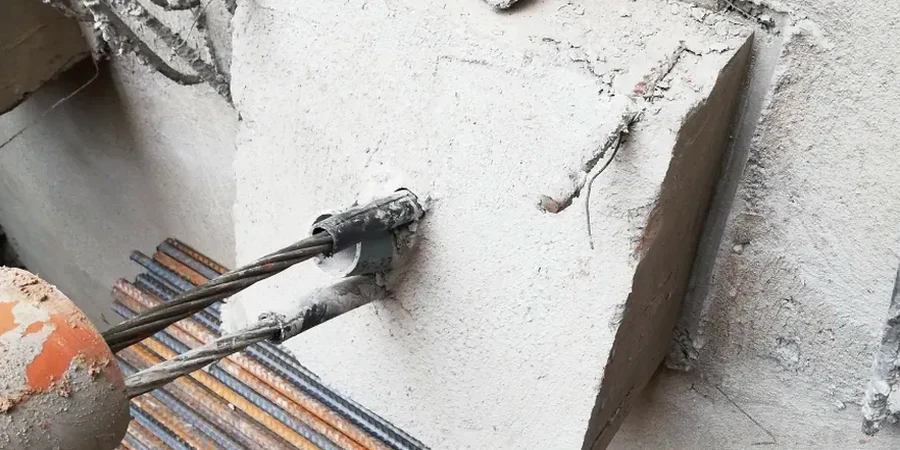
The hydraulic stressing jack mounted on a mobile reaction frame is the tool we see most often on Chilliwack job sites these days, where active and passive anchor design starts with a clear understanding of the stratified fluvial deposits that characterize the Fraser Valley. Our laboratory team works directly with these field setups, verifying lock-off loads and unbonded lengths against the soil parameters we measure from split-spoon samples and Shelby tubes recovered in the immediate area. When a contractor in Chilliwack needs a tieback that will hold in loose to medium-dense sands overlying glacial till, the design must account for the groundwater regime that fluctuates with the Vedder River, and that means our bond length calculations are never generic. We prepare the anchor design package with site-specific friction ratios and grout-to-ground bond values derived from local experience rather than textbook tables, which is what makes the difference between a tendon that creeps under load and one that stays locked for the life of the structure. For projects where anchor loads must be verified under dynamic conditions, we often coordinate our design with seismic monitoring and excavation instrumentation to capture real-time load redistribution during construction stages.
Anchor bond length in Chilliwack is governed by the contact between grout and native silty sand, not by the steel tendon capacity, and we prove that through load testing on every project.
Our approach and scope
In Chilliwack, we frequently observe that the transition zone between Holocene alluvium and the underlying Vashon till behaves unpredictably during anchor installation, particularly when the borehole crosses cobble lenses that are common near the Sardis escarpment. This is not something a standard design chart captures, and it is exactly why our anchor designs specify both the grout injection pressure and the casing advancement method based on what the driller is likely to encounter at a given depth. Our laboratory runs unconfined compressive strength tests on grout cubes cured under site-representative temperature conditions because grout performance in a February pour at 4°C is not the same as a July pour at 28°C, and we have seen this play out in load test results across the eastern Fraser Valley. We define the unbonded length to extend well past the critical failure surface, and for active anchors we calculate the lock-off load to offset anticipated relaxation losses in the silt-dominated layers that often sit between sand units. Passive anchors, by contrast, are designed to mobilize resistance through deformation, which means our soil-structure interaction models rely on p-y curves calibrated to the actual stiffness of the native material. This level of detail is what keeps a shoring wall in downtown Chilliwack performing within the deflection limits set by the structural engineer when adjacent buildings date from the 1960s and have limited tolerance for movement.
Site-specific factors
A six-meter-deep excavation on Yale Road for a mixed-use building exposed what we have come to expect in central Chilliwack: a layer of loose sandy silt at 3 to 5 meters depth that simply does not develop the bond stress that a uniform sand profile would predict. The contractor had assumed a grout-to-ground bond of 150 kPa based on a report from another region, and the first two proof tests showed creep rates well above the PTI limit. We redesigned the anchor bond length on the spot, increasing it by 40 percent and specifying a staged grouting procedure with a water-cement ratio of 0.45 to prevent bleed water from pooling at the top of the bond zone. The risk in Chilliwack is not that the soil is inherently weak, but that it is heterogeneous in ways that only local drilling experience reveals, and an anchor design that ignores the presence of interbedded silt seams will fail a proof test even if the numbers look fine on paper. For deeper excavations that reach into the till, the risk shifts to installation refusal on boulders, which is why our specifications include contingency language for shifting anchor locations within a pre-approved corridor without compromising the global stability of the wall.
Reference standards
PTI DC35.1-14: Recommendations for Prestressed Rock and Soil Anchors, CSA A23.3: Design of Concrete Structures (Annex D – Anchorage), ASTM A416: Standard Specification for Low-Relaxation, Seven-Wire Steel Strand for Prestressed Concrete, ASTM C109: Standard Test Method for Compressive Strength of Hydraulic Cement Mortars, FHWA-NHI-05-039: Micropile Design and Construction Guidelines (anchor testing procedures)
Frequently asked questions
How much does active and passive anchor design cost for a project in Chilliwack?
Anchor design fees in Chilliwack typically fall between CA$1,420 and CA$4,670 depending on the number of anchor rows, the complexity of the stratigraphy, and whether the project requires proof testing supervision. A single-tier anchored wall with four to six production anchors at a residential site will be at the lower end, while a multi-row commercial excavation requiring extended creep tests and load cell monitoring on multiple tendons will push toward the upper end of that range.
What is the difference between an active anchor and a passive anchor?
An active anchor is prestressed after grouting, meaning we apply a lock-off load typically at 110 percent of the design working load using a hydraulic jack, which immediately compresses the soil behind the wall and limits movement. A passive anchor is not prestressed; it develops its resisting force only when the wall moves enough to stretch the tendon, which makes it suitable for temporary cuts where some deflection is acceptable or where adjacent structures are not sensitive to movement.
How do you determine the bond length for an anchor in Chilliwack soils?
We determine the bond length from the site-specific grout-to-ground bond stress, which we estimate initially from SPT N-values and soil classification of the bond zone material, and then we verify it through field pull-out tests on sacrificial anchors before production drilling begins. In the silty sands and interbedded deposits common across Chilliwack, the preliminary bond stress typically ranges from 80 to 120 kPa, but the final bond length is always confirmed by proof testing at 133 percent of the design load.
How long does anchor design and testing take for a typical retaining wall project?
The design phase, once we have the geotechnical site investigation data, usually takes one to two weeks to prepare the anchor schedule, bond length calculations, and testing specifications. The field testing component runs in parallel with anchor installation: proof tests are performed a minimum of 72 hours after grouting to allow for adequate strength gain, and a full testing program on a wall with ten to fifteen anchors typically spans three to five working days on site.