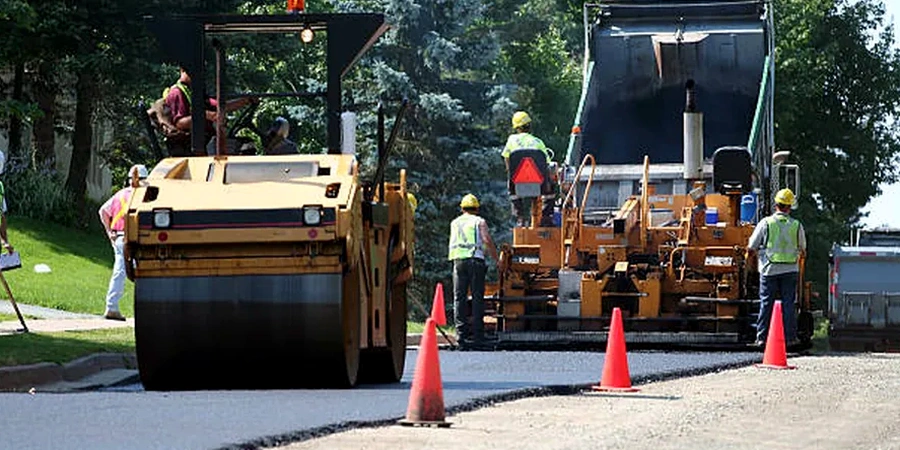
With annual precipitation exceeding 1,700 mm and floodplain silts deposited by the Fraser River, Chilliwack presents a demanding environment for flexible pavement design. The city sits at just 10 m above sea level, and the shallow groundwater table — often within 1.5 m of the surface from October through April — keeps subgrade moisture at near-saturation for months. These conditions drive differential frost heave in winter and bearing-capacity loss during spring thaw, both of which directly reduce the structural number of an asphalt section unless the design accounts for local hydrology from the start. Our team combines laboratory resilient modulus estimates with field CBR values to produce pavement structures that survive Chilliwack’s wet-freeze climate without premature rutting, alligator cracking, or subbase pumping.
A 2 percent CBR difference in saturated subgrade can cut pavement life in half — we measure it, we model it, we design for it.
Reference standards
AASHTO Guide for Design of Pavement Structures (1993, with 1998 supplement), ASTM D1883-21 — Standard Test Method for California Bearing Ratio (CBR) of Laboratory-Compacted Soils, ASTM D1557-12(2021) — Standard Test Methods for Laboratory Compaction Characteristics of Soil Using Modified Effort, BC MoTI Standard Specifications for Highway Construction, Section 302 — Granular Base and Sub-Base
Frequently asked questions
How does Chilliwack’s high water table affect flexible pavement design?
A shallow water table keeps the subgrade near saturation, drastically reducing its CBR and resilient modulus. Our design protocol uses soaked CBR values — not dry or field-moisture readings — to represent the worst-case spring condition. We also increase the drainage coefficient in the AASHTO equation and often specify a thicker granular base to separate the asphalt layer from the saturated subgrade, preventing capillary rise that would otherwise soften the base course.
What CBR value do you target for residential streets versus arterial roads in the Fraser Valley?
For local residential streets with low truck traffic, a soaked subgrade CBR of 3 to 5 percent is typically sufficient with an appropriate base thickness. Arterial corridors carrying heavy agricultural and commercial vehicles require a minimum of 8 percent CBR in the subgrade; if native soils cannot achieve that after compaction, we specify lime stabilization or a thicker granular replacement layer to reach the target structural number.
What is the typical cost range for flexible pavement design services in Chilliwack?
Depending on the length of the alignment, the number of test pit or borehole locations, and the laboratory testing scope, pavement design packages in Chilliwack generally range from CA$2,270 for a short residential driveway with basic CBR testing to around CA$7,910 for a full arterial road investigation including Proctor, grain-size, and multiple structural sections with life-cycle analysis.
Do you use the AASHTO 1993 method or the mechanistic-empirical pavement design guide for Chilliwack projects?
We default to the AASHTO 1993 method because British Columbia’s Ministry of Transportation and Infrastructure still bases its standards on that framework, and the local calibration coefficients for the Fraser Valley are well established. For projects with unusual loading spectra or where the client requests a performance-based analysis, we supplement with mechanistic-empirical checks using layered elastic models to verify tensile strain at the bottom of the asphalt and compressive strain on top of the subgrade.