Together, we solve the challenges of tomorrow.
LEARN MORE →Ground improvement encompasses a suite of geotechnical techniques designed to enhance the engineering properties of soil and rock, making them suitable for construction. In Chilliwack, a city experiencing steady growth in residential, commercial, and infrastructure development, these methods are not merely optional—they are often essential. The region's complex glacial and alluvial deposits frequently present challenges such as loose sands, soft silts, and compressible clays, which can lead to unacceptable settlements or bearing capacity failures if left untreated. By modifying the ground, engineers can mitigate seismic risks, control groundwater, and create stable platforms for everything from single-family homes to large-scale industrial facilities.
The local geology of Chilliwack is dominated by the legacy of the Fraser River and its ancestral channels, which have deposited thick sequences of sediments across the valley floor. Much of the city is underlain by loose to medium-dense sands and silts, often with a high water table that complicates excavation and foundation work. These soils are susceptible to liquefaction during earthquakes—a critical concern given British Columbia's seismic setting. Additionally, pockets of soft, organic-rich clay can be encountered, particularly near former sloughs and low-lying areas. This variability demands a thorough subsurface investigation and a tailored approach to ground treatment, ensuring that the solution matches the specific soil profile and performance requirements.
In Canada, ground improvement design must comply with national and provincial standards that prioritize safety and long-term performance. The National Building Code of Canada (NBC) provides overarching requirements for foundation design, referencing the Canadian Foundation Engineering Manual (CFEM) as the primary geotechnical resource. In British Columbia, the BC Building Code adopts the NBC with supplementary provisions, and engineers must adhere to the Professional Governance Act and standards set by Engineers and Geoscientists BC (EGBC). For seismic design, the site-specific hazard assessments in the NBC 2020 are critical, as they dictate the level of ground improvement needed to achieve acceptable performance. All designs must be sealed by a qualified professional, ensuring accountability and adherence to rigorous technical and ethical guidelines.
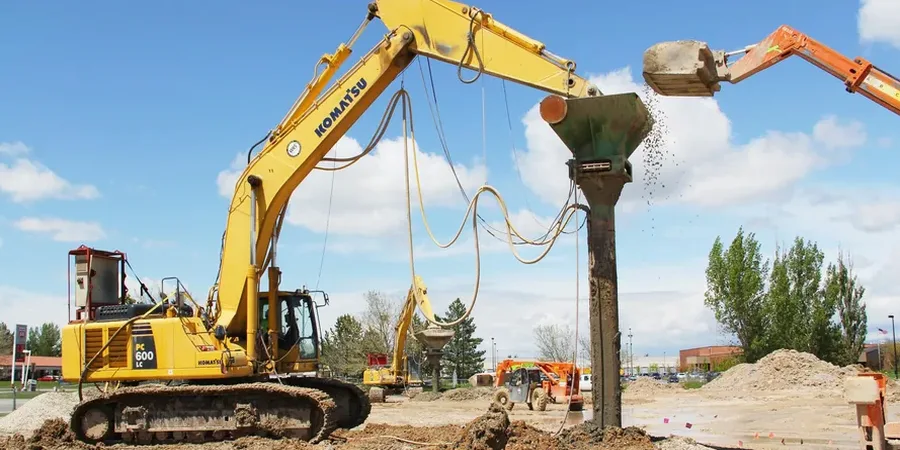
The types of projects in Chilliwack that routinely require ground improvement are diverse. Light industrial and warehouse developments in the expanding commercial parks often need densification of granular soils to support heavy racking loads and forklift traffic. Residential subdivisions on marginal land may require treatments to stabilize soft soils and prevent differential settlement. Infrastructure projects, such as road widenings and bridge approaches, benefit from techniques that reinforce the ground against repetitive loading. For projects where deep, loose deposits pose a liquefaction risk, methods like stone column design are frequently employed to provide both densification and drainage. In areas with cleaner sands and a need for uniform compaction, vibrocompaction design offers a proven and efficient solution. Each technique is selected based on a rigorous analysis of soil conditions, project loads, and performance criteria, ensuring a cost-effective and reliable outcome.
Ground improvement aims to permanently enhance soil properties such as strength, stiffness, and permeability. This reduces settlement, increases bearing capacity, and mitigates liquefaction risk, making otherwise unsuitable ground safe for building foundations, roads, and other infrastructure without the need for deep, costly replacement.
It becomes necessary when a geotechnical investigation reveals soils that cannot safely support proposed loads in their natural state. Indicators include loose sands prone to earthquake liquefaction, thick layers of soft clay causing excessive settlement, or a high water table that would destabilize conventional shallow foundations.
Chilliwack's glacial and alluvial soils vary widely, from loose river sands to soft silty clays. The presence of a high water table and seismic activity dictates that methods must address both densification and drainage. Granular soils often suit vibrocompaction, while mixed or cohesive soils may require stone columns for reinforcement and pore pressure relief.
Designs are governed by the National Building Code of Canada and the Canadian Foundation Engineering Manual (CFEM), with provincial oversight from the BC Building Code and Engineers and Geoscientists BC (EGBC). These standards mandate site-specific seismic assessments, professional sealed designs, and adherence to proven, documented construction methodologies.