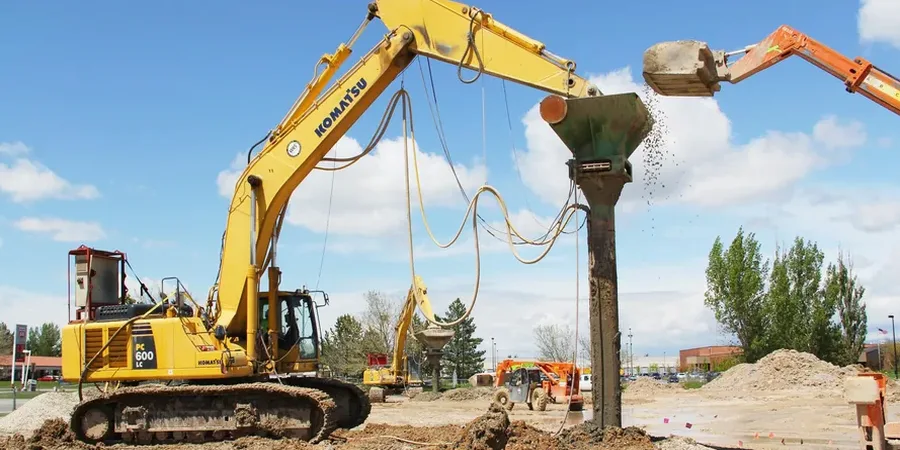
Chilliwack’s growth from a small agricultural settlement on the banks of the Fraser River into a thriving Fraser Valley hub has placed tremendous demand on its buildable land. Much of the city sits atop deltaic deposits of silty sands and gravels, remnants of ancient river channels that shifted course over millennia. For anyone developing a commercial lot in Sardis or a warehouse near the airport, those loose granular soils are a serious headache. We’ve seen firsthand how conventional over-excavation turns into a waterlogged nightmare once you hit the high water table. That’s where vibrocompaction design comes in—a deep densification technique that uses a vibrating probe to rearrange soil particles without removing material. On a recent industrial project near Chilliwack Mountain, combining our CPT testing data with vibrocompaction specifications allowed the owner to skip costly deep foundations entirely. The result was a uniform, densified platform ready for conventional footings, and a project that stayed on budget.
A well-designed vibrocompaction program can double the relative density of loose alluvial sands, reducing post-liquefaction settlement to under 25 mm.
Our approach and scope
The 2020 National Building Code of Canada (NBCC) and CSA A23.3 place strict requirements on bearing capacity and total settlement, especially in a seismically active zone like the Fraser Valley. Chilliwack sits roughly 100 km from the Cascadia Subduction Zone, so long-period ground motion is a real design consideration. Vibrocompaction design in this context isn’t just about grabbing a probe pattern from a textbook—it’s about correlating pre-treatment CPT or SPT data with target relative density values, usually 70% to 85% depending on the structure’s importance category. We specify probe spacing, vibration frequency, and duration based on the grain-size distribution of the site. If the fines content creeps above 15%, the technique’s effectiveness drops, and we often recommend a pilot test zone to verify performance. For mixed profiles, integrating a
stone column solution near the silt lenses can bridge the gap between pure densification and reinforcement. The design deliverable includes a layout plan, depth of treatment, quality control criteria, and post-treatment verification testing—typically CPT or SPT every 250 m² to confirm uniform improvement.
Frequently asked questions
What’s the typical cost range for vibrocompaction design and treatment in the Chilliwack area?
For a standard commercial or industrial lot in Chilliwack, the vibrocompaction design and site treatment typically ranges from CA$1,950 to CA$6,450 depending on depth, grid density, and verification testing requirements. Deeper treatment beyond 15 m or complex alluvial profiles with high fines content push toward the upper end due to additional pilot testing and QC measures.
How do you verify that vibrocompaction actually densified the soil?
We run pre- and post-treatment CPT soundings on a grid matching the probe pattern. The increase in tip resistance and sleeve friction is directly correlated to relative density. For most projects in the Fraser Valley, we target a cone resistance increase of 50–100% above the pre-treatment baseline, with verification tests performed 48 hours after treatment to allow pore pressure dissipation.
Can vibrocompaction be used if there’s a lot of silt in the soil?
It depends on the percentage. In Chilliwack’s alluvial deposits, fines content often hovers between 8% and 18%. Below 12–15%, vibrocompaction works well. Above that threshold, silt particles clog the drainage paths and the soil won’t densify properly under vibration. In those cases, we often switch to stone columns or combine both techniques—vibrocompaction in clean sand zones, stone columns where silt lenses dominate.
How long does the vibrocompaction process take on a typical Chilliwack site?
For a 2,000 m² commercial lot with treatment to 12 m depth, the field work typically takes 5 to 8 working days using a single vibro rig. The design and reporting phase runs concurrently, with the verification report delivered within 7 days of completing post-treatment CPTs. Rain delays are rare in summer but the Fraser Valley’s fall groundwater rise can slow access, so we factor that into the schedule.