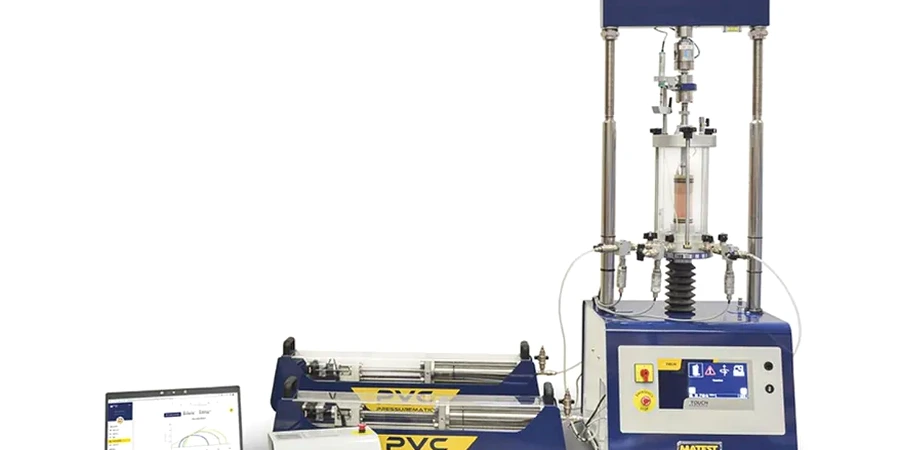
A triaxial cell sits in the loading frame, confining pressure lines attached, pore pressure transducer calibrated to zero. In Chilliwack, where the subsoil shifts from dense glacial till north of the Trans-Canada to soft compressible silts along the Vedder River fan, that cell holds the answer to whether your foundation will settle 15 millimeters or 50. We run consolidated-undrained and drained tests on Shelby tube samples extracted from depths where the water table sits barely two meters below grade—typical for the Sardis lowlands and the floodplain east of Evans Road. The data feeds directly into bearing capacity calculations under NBCC 2020 and CSA A23.3, giving structural engineers the effective friction angle and cohesion intercept that standard penetration testing alone cannot resolve. When a CPT test profile shows a weak lens at 6 meters, the triaxial confirms whether it behaves as normally consolidated clay under the additional service load.
A CU triaxial test with pore pressure measurement often reveals an effective friction angle 5 to 8 degrees lower than the total-stress value assumed from SPT correlations—enough to double the required footing width.
Site-specific factors
Chilliwack's development arc—from the original downtown grid surveyed in the 1890s to the post-2000 subdivisions pushing up against the Eastern Hillsides—has placed buildings on at least four distinct geological units: glaciomarine stony clay, post-glacial alluvial silts, Vedder River coarse channel deposits, and colluvium at the valley margins. Each unit behaves differently under shear. The 1946 Fraser River flood deposited a meter of silt across the low-lying areas south of Chilliwack Central Road; that layer, now buried under thin fill, has produced triaxial undrained shear strengths as low as 15 kPa in our lab. A footing sized for 150 kPa bearing based on a hand penetrometer reading would fail here. The triaxial test eliminates that gap, providing the effective stress parameters that a slope stability analysis needs for the hillside lots, where groundwater perched on the till contact triggers shallow translational slides every five to seven years.
Reference standards
ASTM D4767-19 (Consolidated Undrained Triaxial Compression on Cohesive Soils), ASTM D7181-20 (Consolidated Drained Triaxial Compression), ASTM D2850-15 (Unconsolidated Undrained Triaxial Compression), ASTM D4318-17 (Atterberg Limits for classification integration), NBCC 2020 (structural design referencing soil parameters), CSA A23.3-14 (concrete structures, foundation clauses)
Frequently asked questions
What does a triaxial test cost in Chilliwack?
A standard CU triaxial test on one specimen runs between CA$2.780 and CA$4.070 depending on the number of confining pressures, the need for back-pressure saturation, and whether undisturbed Shelby tube samples require special handling. A three-specimen suite, which provides the full Mohr-Coulomb envelope, sits in the upper part of that range. We quote per project, not per specimen, because the number of tests depends on the stratigraphy encountered in the boreholes or test pits.
How long does a triaxial test program take?
A consolidated-undrained test on a single specimen typically requires 5 to 7 working days from sample extrusion to final data report, because the consolidation and shear phases are run at controlled strain rates that cannot be accelerated without invalidating the results. A full three-specimen suite adds another 3 to 4 days. Rush processing is available when construction schedules demand it, though the physics of pore pressure equalization sets a hard lower bound on timeline.
Which triaxial protocol does a foundation engineer need for Chilliwack's silty soils?
For the soft compressible silts common south of the Trans-Canada, a CU test with pore pressure measurement is the minimum—it provides both total and effective stress parameters so the geotechnical engineer can check short-term stability during excavation and long-term settlement under the completed structure. If the project includes a basement below the water table, we recommend adding a CD test on the bearing stratum to capture the drained friction angle accurately.
Can triaxial results replace SPT data for bearing capacity?
They complement each other. The SPT gives a continuous profile of relative density and consistency with depth; the triaxial test provides the shear strength parameters—friction angle and cohesion—at specific critical layers that govern bearing capacity failure. You cannot derive a reliable effective friction angle from blow counts alone in the Fraser Valley's interbedded silts and clays, so the triaxial becomes the reference data that calibrates the SPT-based empirical correlations for the rest of the profile.